AI system design
One page that ties the topics together. Each topic teaches one box; this page shows the whole request path, a method to size it, and a worked example. Read it after two or three topics, and again after the RnR capstone. Words you don't know are in the glossary.
1. The request path
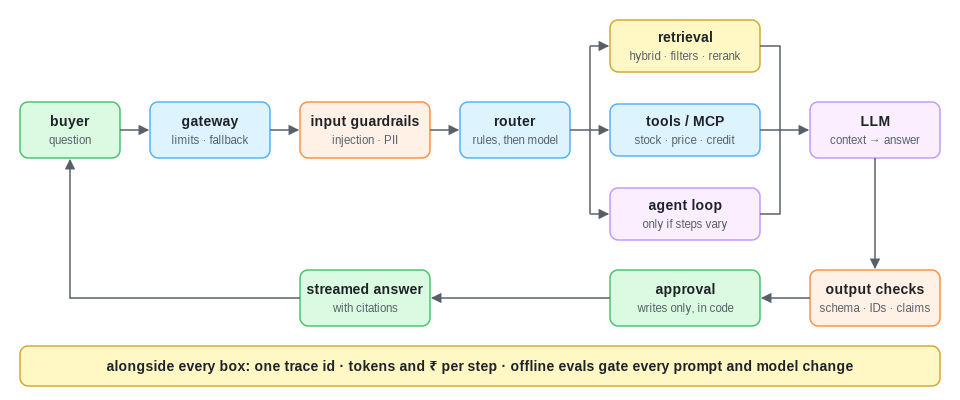
Almost every AI feature is this path with some boxes switched off. A one-shot classifier uses three boxes; the WhatsApp agent uses all of them.
| Box | What it does | Where you built it | Rule of thumb |
|---|---|---|---|
| Gateway | One door for every model call: keys, rate and token limits, retries, fallback model, cost log | rnr 09 (cost meter on the one door, ai/llm.py), 11 (ai/gateway.py: budgets, rate limits, retries, fallback; LiteLLM compared) |
Never let app code call a model provider directly |
| Input guardrails | Block or clean bad input: injection, PII, off-topic, abuse | prompting/05, rnr 01, 03, 04 |
Cheap rules first, a model only for what rules can't see |
| Router | Pick the path: which tools, which agent, or a human | llm-api/07, multi-agent/02, whatsapp-agent/06 |
Rules for the obvious, a small model for the rest, a human for the unsure |
| Retrieval | Find the passages that answer the question | rag 03 to 10 |
The model only sees what search hands it |
| Tools / MCP | Live facts and actions: stock, price, credit, orders | llm-api, mcp-server |
Facts that change by the minute come from tools, not documents |
| Agent loop | Let the model pick the next step, within a budget | agents, multi-agent |
A workflow first; an agent only when the steps depend on results |
| LLM | Turn context into language | every topic | Swappable behind one chat() signature |
| Output checks | Schema, amounts, IDs, claims, citations | prompting/03, 05, llm-api/05, agents/03, whatsapp-agent/04, 08 |
Code checks facts; a judge checks what code can't see |
| Approval | A person confirms anything that writes or costs money | llm-api/06, agents/06, multi-agent/05 |
The model asks; code decides; a human signs |
| Traces, cost, evals | See every step, price every call, score every change | prompting/04, rnr phases 2, 3, 5 |
No prompt or model change ships without an eval run |
2. The method: seven steps before code
Classic system design works for AI too. Three steps need AI-specific questions.
| Step | Ask | AI-specific question |
|---|---|---|
| 1. Functional requirements | What must it do? | Which parts need language, and which are plain code? |
| 2. Non-functional requirements | How well, how fast, how safe? | Quality bar as an eval score, time to first token, ₹ per request, what data may leave the building, fail open or closed |
| 3. Back of the envelope | Requests, tokens, ₹, memory | Tokens are the unit: tokens per request × requests = cost and capacity |
| 4. Core components | Which boxes from section 1? | Which boxes can stay off for v1? |
| 5. High-level design | How do the boxes connect? | Where does the model sit, and what can it never do (write, approve, calculate)? |
| 6. Low-level design | Data model, APIs, prompts | Prompts and eval sets are versioned code |
| 7. Trade-offs | What did we give up? | Quality vs latency vs cost: you pick two per box |
3. Worked example: "Ask Acme Build", a buyer assistant
Functional. MSME buyers ask in English or Hinglish about policies and specs (RAG), and about their own prices, stock and order status (tools). It can draft a reorder, but a person confirms it.
Non-functional.
| NFR | Target | How you know |
|---|---|---|
| Quality | 90% correct on a 200-question golden set; 0 wrong prices | rag/09, rnr/05 style eval, run on every change |
| Latency | First token under 1.5 s, full answer under 6 s at p95 | Traces |
| Cost | Under ₹0.10 per question | Cost meter per prompt version |
| Safety | A buyer never sees another tier's price; no order without confirmation | Filters inside tools, approval in code |
| Failure | Model down: answer "try again" and show order status from code | Fallback path tested |
Back of the envelope. Every number is an assumption; write yours down the same way.
| Item | Working | Result |
|---|---|---|
| Volume | 5,000 active buyers × 4 questions | 20,000 questions a day |
| Peak load | 20,000 over 10 business hours, peak hour 3× average | about 1.7 questions a second |
| Tokens per question | input: rules 500 + 5 chunks × 300 + history 500; output 250 | 2,500 in, 250 out |
| Tokens a day | 20,000 × 2,500 and 20,000 × 250 | 50M in, 5M out |
| Cost (hosted model) | assumed rate card ₹20 per 1M in, ₹80 per 1M out | ₹1,400 a day, about ₹0.07 a question |
| In flight at peak | 1.7 a second × 6 s per answer (Little's law) | about 10 answers streaming at once |
| Vector index | 60,000 chunks × 768 dimensions × 4 bytes | about 185 MB, plus index overhead |
| Traces | 20,000 × about 10 KB | 200 MB a day, so set a retention period |
What the numbers tell you:
- Input tokens are 70% of the bill, and most of them are retrieved chunks. Chunk size and k are cost levers, not just quality levers.
- Our Mac can't serve this. qwen3:8b streams one answer at a time at roughly 20 to 30 tokens a second; we need about 10 at once. Production needs a hosted model or a GPU server with continuous batching (vLLM). Ollama is the dev box.
- 185 MB is small. pgvector inside the Postgres you already run is enough; a dedicated vector database earns its place at millions of vectors or very high query rates.
High-level design. FastAPI streams answers. A gateway wraps every model call. Rules and a small model guard input. The router sends policy questions to retrieval (pgvector plus Postgres full-text search, fused with RRF), and account questions to tools on an MCP server over the order and pricing services. Reorders end at a cart card; the Confirm button runs code. Every step writes a span with tokens and ₹.
Latency budget. Where the 6 seconds go:
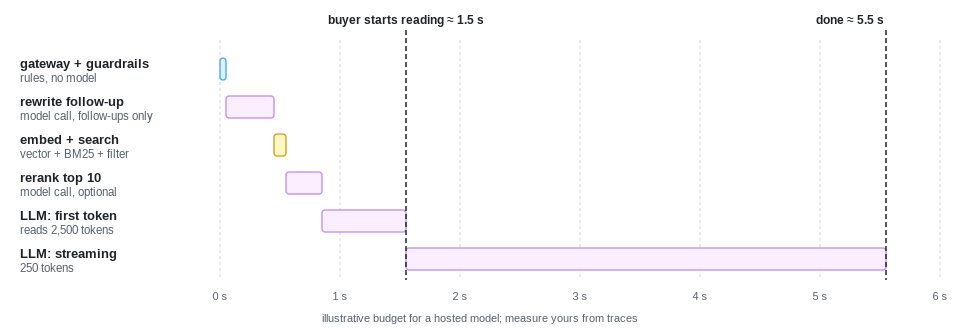
Purple bars are model calls. Each one you add costs 300 ms or more, so add the rewrite and the reranker only when an eval shows they help. Streaming hides the long bar: the buyer starts reading at 1.5 s.
Low-level design. The key details:
chunks(id, doc_id, section, chunk_hash, tier, doc_type, embedding vector(768), tsv tsvector), with an HNSW index onembeddingand GIN ontsv.POST /askstreams Server-Sent Events. Tool writes take an idempotency key.- Prompts live in files with a version; each trace records the prompt version and model.
- The golden set lives next to the code; CI runs the eval when a prompt, model or chunking setting changes.
4. Decisions your team will face
| Decision | Start with | Change when |
|---|---|---|
| Model hosting | A hosted API behind the gateway | Data can't leave, or volume makes a GPU cheaper than the per-token bill |
| Vector store | pgvector in your existing Postgres | Millions of vectors, heavy filtering at high query rates, or the database team says no |
| Framework | Hand-rolled, as in the labs | Durable pauses, branching or many agents: LangGraph or similar |
| Router | Rules plus one small model call | Rules sprawl past a few dozen: a trained classifier |
| Caching | Prompt caching for the fixed system prompt | Many repeated, non-personal questions: a semantic cache, with tier in the key |
| Quality gate | A golden set of 50 to 200 cases in CI | Real traffic shows new failure types: add them from traces every week |
5. What the labs don't cover
- Serving at scale: GPU sizing, vLLM, continuous batching, KV-cache memory. The envelope above tells you when you need them.
- Multi-tenant isolation: per-customer keys, limits and data separation across many companies.
- Model upgrades: pinning versions and re-running every eval before a provider's new model goes live.
- Data residency and audit: where prompts and traces are stored, and for how long.
6. How deep to go, by experience
| You are | Do this with this page |
|---|---|
| Early career (1 to 4 years) | Read section 1 and find each box in code you've run. Skip the rest for now. |
| Mid to senior engineer (4 to 10 years) | Sections 1 to 3. Redo the envelope for a feature you own. |
| Architect or lead (10 years and more) | All of it. Use section 2 as the review template for every AI design doc, and For architects for context, frameworks and fine-tuning. |
| Engineering leader | Sections 2 and 4. Ask every team for their NFR table and envelope before approving a build. |
Same pattern, other industries
| Industry | Use case | What changes |
|---|---|---|
| Banking | Loan-policy assistant | Approval is regulated; every answer needs a citation and an audit trail |
| Healthcare | Clinical guideline Q&A | Fail closed by default; a clinician signs off; PII never reaches a hosted model |
| Logistics | Shipment-status agent | Mostly tools, little RAG; latency matters more than wording |
| Retail (B2C) | Shopping assistant | 100× the volume, so caching and a small model carry most traffic |
Going deeper
| Topic | What it solves | Search terms |
|---|---|---|
| LLM serving | Many users on one GPU | vLLM PagedAttention, continuous batching |
| AI gateways | Limits, fallback and cost across providers | LiteLLM proxy, AI gateway rate limiting |
| Capacity planning | Sizing GPUs from tokens | LLM throughput tokens per second per GPU |
| Semantic caching | Skipping repeated model calls | semantic cache LLM, GPTCache |
| Model routing | Small model first, big model when needed | LLM cascade, model routing |
Try it: redo the envelope for the WhatsApp agent: 2,000 stores, 6 messages a day each, measured tokens from its traces. Time qwen3:8b with ollama run qwen3:8b --verbose (it prints the eval rate in tokens a second) and work out how many Macs you'd need.
Next: the glossary, for every term on this page.